 Our Location
  (972) 315-6100
 (972) 315-6100
The best age to start orthodontic treatment is guided by dental development, not birthdays. The American Association of Orthodontics recommends a first evaluation by age 7. Most full treatment begins between ages 10 and 14, once permanent teeth arrive. Adults can start at any age with healthy teeth and gums.
Why age 7? That’s when the first permanent molars and front incisors settle into place. Those teeth act like a preview. Dr. Anabella Henao can see how the bite is coming together, whether the upper and lower jaws line up, how much room the remaining permanent teeth will have, and how the airway is developing.
Here’s the part that surprises most parents: an early evaluation rarely leads to early braces. Many kids just come in for check-ins while their teeth and jaws develop. Others benefit from a short, focused Phase I that will prevent patients from dealing with impacted teeth or surgical exposure. Dr. Henao does not recommend waiting until all permanent teeth erupt to set up your first ortho consultation, as it might be too late to place a regular expander.
For adults, the calendar matters far less than the health of your teeth, gums, and bone. Teeth can be moved at 15 or 55. What changes is the approach, since adult jaws have finished growing.
So the honest answer is this: the right starting point is different for every family, and the only way to know yours is a look at how your teeth are actually developing.
Dr. Henao trained at at Boston University’s Henry M. Goldman School of Dental Medicine, holds a faculty position at Boston University, and has earned Boston University Medical Group Clinical Excellence Awards. Families also see the same doctor at every visit, so whoever charts a child’s growth in second grade is the same person planning treatment in seventh grade. That kind of continuity matters a great deal when timing is the entire question. And whenever the right moment turns out to be, the goal stays the same: feel confidence in your smile. Smile big with bliss!
How Does Orthodontic Timing Work? Growth, Phases, and Key Stages
Orthodontic timing follows dental development in four stages: a first screening around age 7, growth monitoring visits every 6 to 12 months, an optional early phase between ages 7 and 10, then full treatment once most permanent teeth have come in. Retainers hold everything in place after every phase.
Here’s how that plays out at Bliss Orthodontics:
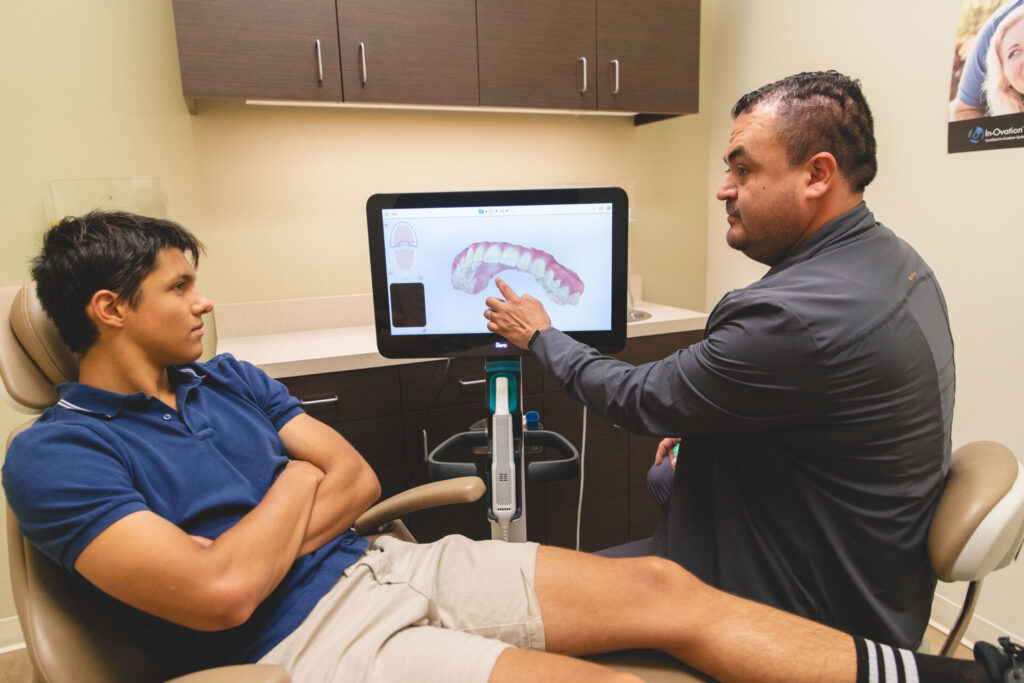
- The age 7 screening. Digital scans, photos, and X-rays give Dr. Henao a clear picture of tooth position, jaw width, and airway space. No goopy impressions involved.
- Growth monitoring visits. If nothing needs correcting yet, we check in every 6 to 12 months while baby teeth leave and permanent teeth arrive. These visits are quick, and they let us catch a shifting bite early.
- Phase I, if it’s needed (roughly ages 7 to 10). Some bites, narrow palates, or habits are much easier to address while the jaws are still soft and growing. Expanders, partial braces, or habit appliances do the work here.
- Phase II or single-phase treatment (usually ages 11 to 14). Once most permanent teeth are in, braces or Invisalign align everything and fine-tune the bite.
- Retention. Every phase ends with a retainer. Teeth like to drift, and retainers are what keep your smile where we put it.
Growth spurts matter a great deal. Widening a narrow upper jaw is far more straightforward before the bones fuse, which is why expansion and MARPE/MSE work best when timed to skeletal development rather than a birthday. Wait too long and the same correction takes more effort.
Benefits of Starting Orthodontic Treatment at the Best Age
Good timing does more than shorten treatment. It changes how much we can do.
- Guides jaw growth. Instead of fighting a narrow jaw later, we help it grow into better proportions and make space for your smile.
- Creates room for erupting teeth. Permanent teeth that have somewhere to go tend to come in straighter on their own.
- Can reduce or avoid extractions. Creating width early sometimes means fewer teeth need to come out later, and it can help families sidestep more involved jaw correction in adulthood.
- Supports better breathing. A wider palate opens the nasal passage so air moves smoothly. For kids who mouth-breathe or snore, that’s a real quality-of-life change. Give yourself room to breathe.
- Protects front teeth. Upper teeth that stick out are more vulnerable during sports and playground spills. Tucking them in lowers that risk.
- Simplifies the second round. Kids who complete a well-timed first phase often need a shorter, more straightforward finish.
- Builds confidence at the right moment. Middle school is a lot. Feeling good about your smile through those years matters more than we sometimes admit.
Dr. Henao has spent years watching how early decisions shape later smile goals, and that long view shows up in how carefully she times each recommendation. Her guidance follows American Association of Orthodontics standards rather than a one-size template, and every plan is built around the child in the chair. No cookie-cutter fixes here.
Phase I vs. Phase II vs. Teen and Adult Treatment
Not every child needs two phases. Most need one well-timed round. Here’s how the tracks compare:
| Track | Typical age | Main goals | Usual length | Common appliances |
|---|---|---|---|---|
| Phase I (early treatment) | 7 to 10 | Widen a narrow jaw, correct a crossbite, stop harmful habits, make room for permanent teeth | About 6 to 12 months | Expander, partial braces, habit appliance |
| Growth monitoring | 7 to 11 | Watch development, time treatment correctly | Check-ins every 6 to 12 months | None |
| Phase II | 11 to 14 | Align all permanent teeth, detail the bite | Commonly 12 to 24 months | Metal braces, clear braces, or Invisalign |
| Teen single-phase | 11 to 16 | Full correction in one round | Commonly 12 to 24 months | Braces or Invisalign |
| Adult treatment | Any age | Alignment, bite function, airway support, fixing teeth that shifted back | Varies with the case | Invisalign, clear braces, metal braces, MARPE/MSE |
Phase I is targeted. We’re solving one or two specific things while growth is on our side, not straightening every tooth.
Phase II is the finishing work. Braces or clear aligners bring all the permanent teeth into position and settle the bite.
Teens make fantastic candidates for single-phase treatment. Permanent teeth are in, growth is still active, and self-ligating metal braces or Invisalign both move things efficiently.
Adults often bring a second layer to the conversation. Worn tooth edges, teeth that shifted back after childhood braces, snoring, or restless sleep all point toward looking at the airway alongside alignment. Dr. Henao’s airway-centered treatments address both.
How Much Does Orthodontic Treatment Cost by Age?
Cost and treatment length depend on case difficulty, appliance type, and whether the plan runs one phase or two. Guiding growth early is usually simpler than correcting a finished bite later. Insurance benefits, HSA/FSA dollars, and monthly financing all shape what families actually pay.
The main factors:
- Case difficulty. A mild crowding case and a significant bite correction sit at different ends of the range.
- Guiding versus correcting. Working with active growth generally takes less time than reversing a fully developed bite.
- Appliance choice. Expanders, metal braces, clear braces, and Invisalign each carry different costs and timelines.
- One phase or two. Two-phase plans spread cost over more years, though the total months in treatment often even out.
- Cooperation. Aligner wear time, elastics, and appliance care move the finish line closer or push it back. This one is genuinely in your hands.
- Financing & insurance. Many plans include orthodontic benefits. Our payment calculator is online, and we help sort out coverage before you commit.
Age plays into the math in a quiet way. A narrow upper jaw widened during active growth typically calls for one appliance and a handful of months. The same width gained after the palate has fused asks for a different set of tools and a longer timeline, which is why early evaluations tend to keep both options and budgets open. Two-phase plans can look like more on paper, yet each phase is often shorter and lighter than a single late correction would be.
Worth knowing: the first evaluation at Bliss Orthodontics is a free consult. Checking a developing bite at age 7 costs nothing and can spare a family far more involved care down the road.
Signs Your Child (or You) May Be Ready to Start Orthodontic Treatment
You don’t need a dentist’s referral to get answers, and a first evaluation is worth putting on the calendar whenever something looks off. These are the patterns Dr. Henao watches for, and any single one of them is reason enough to have development checked.
In children:
- Baby teeth that fall out much earlier or later than siblings’ did
- Permanent teeth coming in twisted, overlapping, or in odd spots
- Crowding, or teeth that clearly have nowhere to go
- A crossbite, underbite, deep bite, or open bite you notice while they chew
- Mouth breathing, snoring, restless sleep, or waking up tired
- Thumb sucking that continues past age 5
- A jaw that shifts to one side when biting down, or joints that click
- Trouble biting or chewing, or speech concerns
In teens and adults:
- Teeth that have shifted since childhood braces
- Worn or chipped edges on front teeth
- A bite that feels uneven or tires your jaw
- Snoring, gasping during sleep, or daytime fatigue that points toward sleep apnea
Sleep apnea is a condition where breathing repeatedly stops and starts during sleep, which can lead to fatigue, trouble concentrating, and other health concerns. Narrow palates, small jaws, or crowded teeth can constrict the airway, and orthodontics is often part of the answer.
Frequently Asked Questions About Orthodontic Timing
Is age 7 too early for braces?
Age 7 is the right time for an evaluation, not necessarily for braces. The American Association of Orthodontics recommends that first check by age 7 because the earliest permanent teeth reveal how the bite and jaws are developing. Many 7-year-olds leave with nothing more than a follow-up visit scheduled.
Will an expander change my child’s face?
An expander widens the upper jaw, so it can subtly broaden the smile and open the nasal passage. Parents often notice a fuller, more even smile and easier breathing. It doesn’t reshape facial features dramatically. It guides growth that was already happening toward better proportions.
Are braces uncomfortable?
Expect some soreness for a few days after braces go on and after adjustment visits. Soft foods and over-the-counter relief handle it well. Self-ligating braces skip elastic ties altogether, which means less friction, fewer sore spots, and a more comfortable experience overall.
Should I just wait until all baby teeth fall out?
Sometimes waiting is exactly right, and Dr. Henao will tell you so. Other times waiting costs more, particularly with crossbites, severely narrow jaws, or airway concerns that are much easier to address during active growth. A free consult tells you which category your child falls into.
Am I too old for orthodontic treatment?
No. If your teeth, gums, and bone are healthy, you can straighten your smile at any age. Invisalign and clear braces keep treatment discreet for work and social life. Adult plans sometimes take a bit longer since growth isn’t helping, and we may look at airway function alongside alignment.
How long does treatment take at each age?
Phase I early treatment commonly runs 6 to 12 months. Phase II and single-phase teen treatment typically fall between 12 and 24 months. Adult treatment varies with the case and any bite or airway work involved. Retainers follow every phase to hold your smile goals for the long term.